Case study · 2026 to present
This portfolio, built in public as a frontend work sample
The site you are reading, bilingual, static in Astro with React islands and built like a product, with enforced layers, performance budgets that block the merge and accessibility tested on every page.
Areas
- Frontend
- Infrastructure

Project facts
- Role
- Sole author, from the design and design system to the infrastructure and operations
- Period
- Oct 2026 to present
- Technologies
- Astro · React · TypeScript · Tailwind CSS · WCAG 2.2
- Public links
- Code on GitHub(opens in a new tab)
At a glance
A portfolio says you can do frontend. This one had to prove it with its own code, open for anyone to review.
0.95
minimum Lighthouse performance score per page, measured in CI and required to merge
Source: lighthouserc.json and the repository's CI workflow, October 2026
24
architecture decisions written as ADRs, each with its context and consequences
Source: The repository's docs/adr folder, October 2026
80 kB
cap on compressed client JavaScript, checked on every build
Source: The repository's scripts/check-bundle.mjs, October 2026
The problem
A developer portfolio is usually a template with screenshots, and it does not show how its author works. I wanted the site itself to be my main frontend work sample, so a recruiter or a tech lead could open the repository and find the same rigor I would bring to a product, in Spanish and English, fast on a mid-range phone and accessible to anyone.
Before:Screenshots of projects nobody can inspect.
After:A public repository where every decision is written down and every rule is checked.
Before:A site that looks good on its author's machine.
After:Performance, accessibility and contrast measured on every change, as a visitor gets them.
Before:Adding a project meant touching code.
After:A project is validated content: two files and their images.
The solution
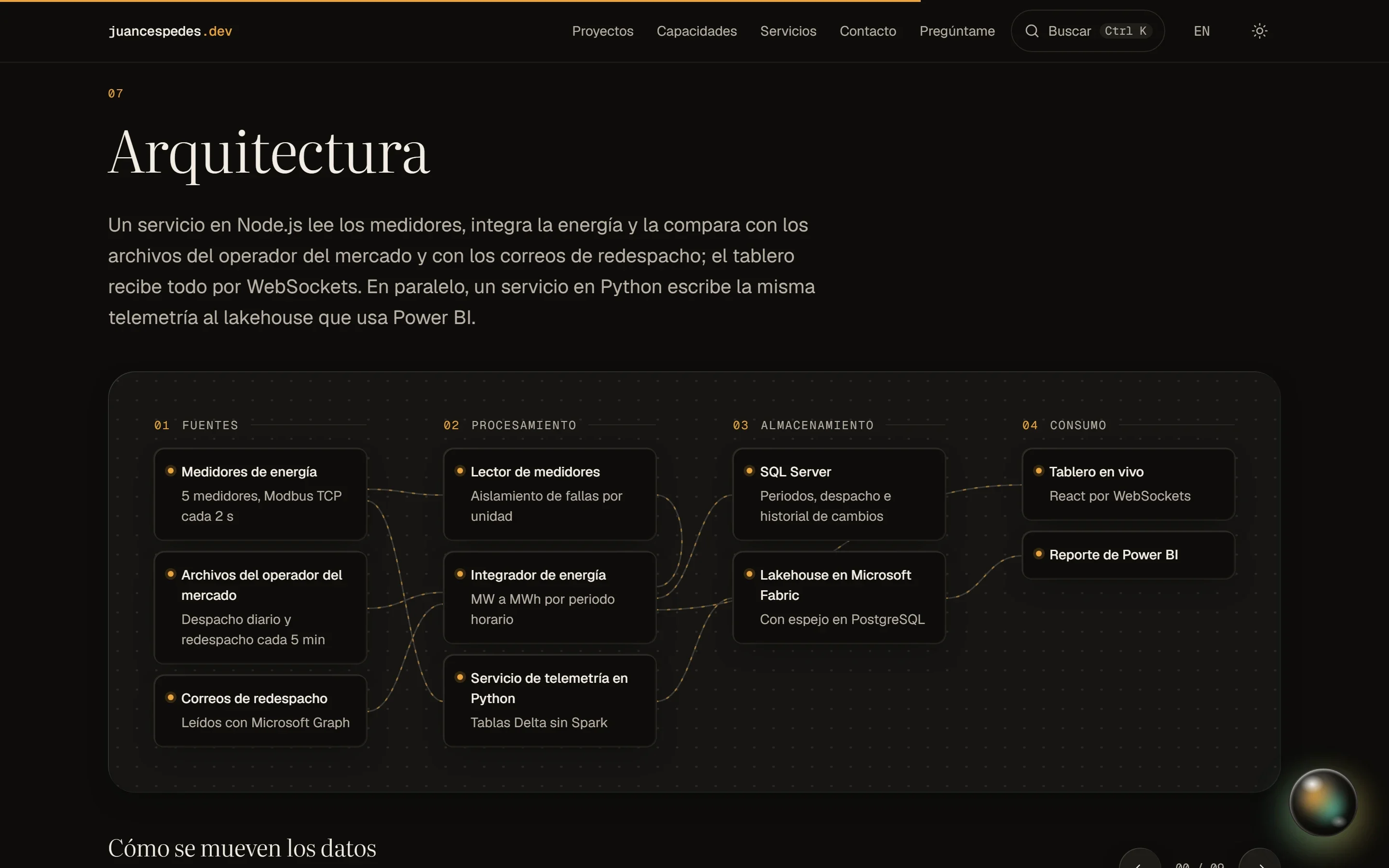
![The architecture diagram of a case study, drawn from the data in the content file and readable without images.]()
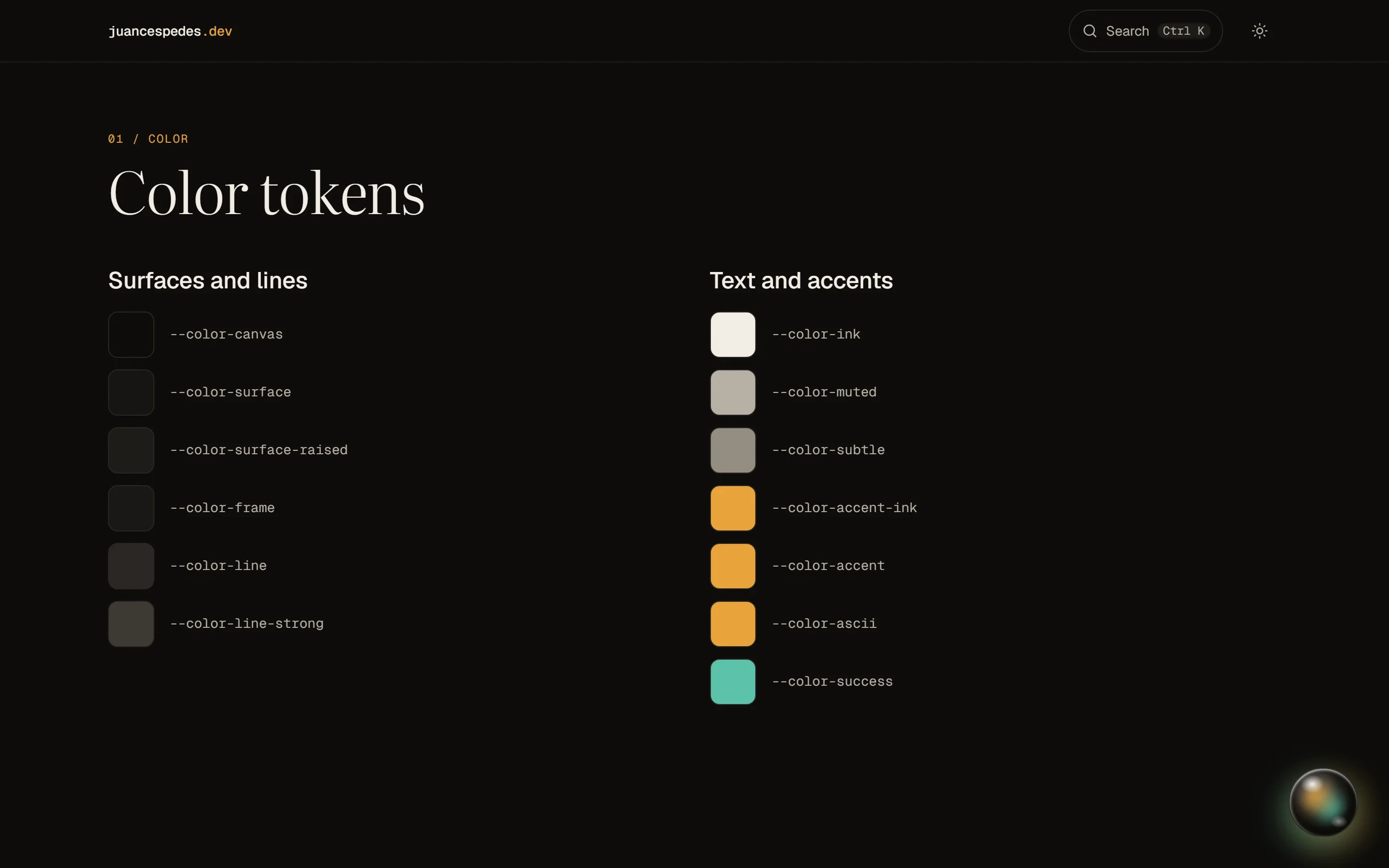
The architecture diagram of a case study, drawn from the data in the content file and readable without images. ![The public design system page: the color tokens that lint enforces and whose contrast the tests verify.]()
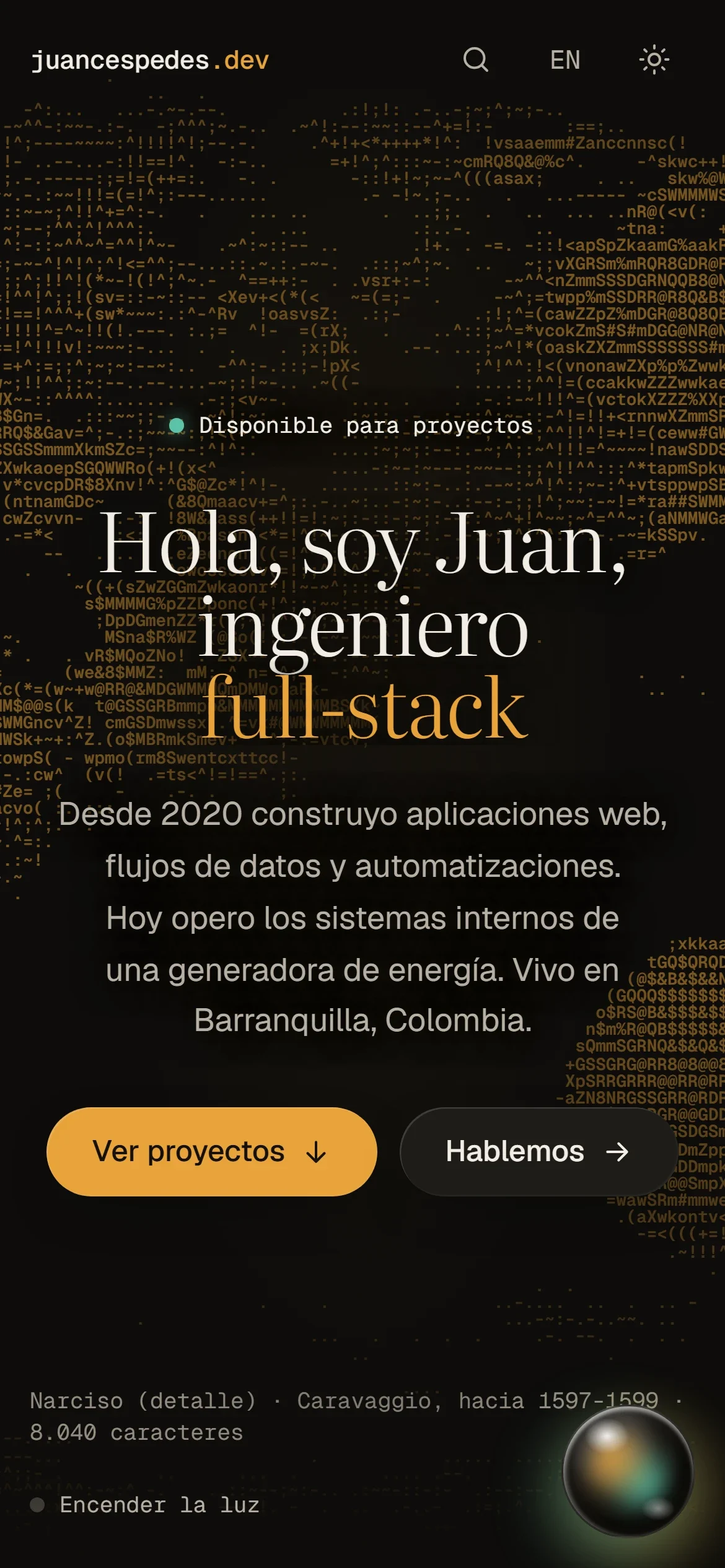
The public design system page: the color tokens that lint enforces and whose contrast the tests verify. ![The home page on a 390 px wide phone.]()
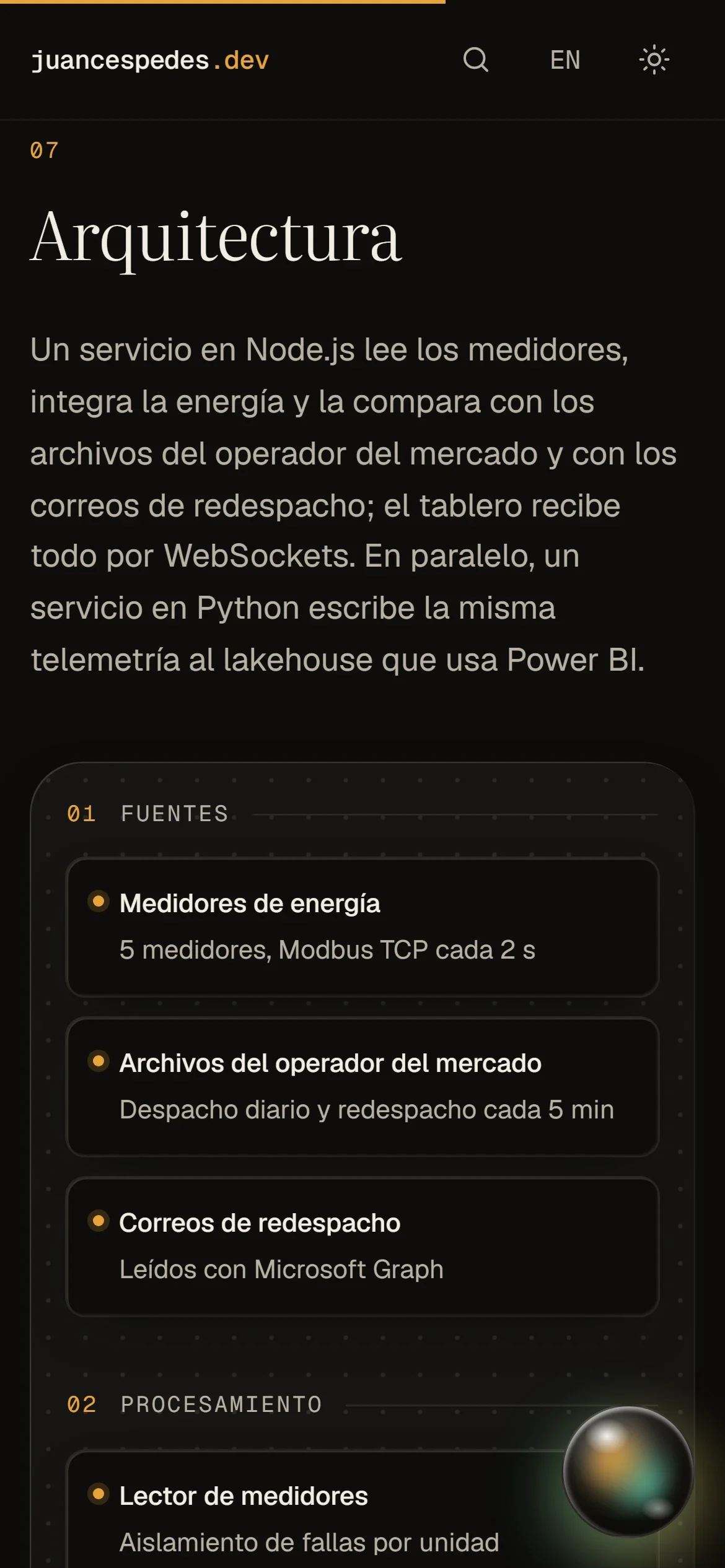
The home page on a 390 px wide phone. ![The architecture diagram on the phone, in a single column.]()
The architecture diagram on the phone, in a single column.
My role
Sole author, from the design and design system to the infrastructure and operations
Designed the visual identity and the design system on tokens, with contrast checked by tests.
Defined the layered architecture and the rules that enforce it on every pull request.
Built the pages, the case studies with diagrams drawn from data, the command palette and the chat.
Set up delivery on Cloudflare Workers, CI with its budgets and operations with monitoring and runbooks.
Constraints
A mostly static site does not justify servers or databases that need upkeep.
Every page must load fast on a phone with a slow connection, with its own fonts and images.
Bilingual content, with neither translation falling behind the other.
Projects built for employers cannot reveal internal systems or real data.
Decisions
Static Astro with React islands
Almost the whole site is content, so it ships as HTML without JavaScript, and only the interactive parts, such as the chat or the command palette, hydrate when they are needed.
Ruled out
- A React single-page application
- Next.js rendering on the server for every visit
A layered architecture even for a small site
Domain, use cases, infrastructure and interface are separate, and two independent tools reject any import that crosses a boundary in the wrong direction.
Ruled out
- Organizing by folders and trusting discipline
Projects are typed content, not pages
Each case study is a file validated by schema and by domain rules, including the architecture diagram, which is described as data and drawn accessibly in both languages.
Ruled out
- An external CMS
- A hand-written page per project
Measure performance as a visitor gets it
Lighthouse runs on the build served with Brotli, the way Cloudflare serves it, and an earlier check fails on render-blocking stylesheets, images that download with the page or HTML over its budget.
Ruled out
- Measuring uncompressed HTML on the preview server
- Checking performance by hand before each release
Architecture
01Content
- Bilingual contentProjects, notes and profile in MDX and YAML
02Build
- Astro with React islandsSchemas, layers and static pages
- GitHub ActionsTests, axe, Lighthouse and budgets
03Edge
- Cloudflare WorkersPages, security headers and API
04Services
- Chat about the workLanguage model with daily quotas
- Contact formEmail delivery with anti-spam
How data moves
- Bilingual contenttoAstro with React islandsValidated on every build
- Astro with React islandstoGitHub ActionsProduction build
- GitHub ActionstoCloudflare WorkersDeploy when everything passes
- Cloudflare WorkerstoChat about the workVisitor questions
- Cloudflare WorkerstoContact formContact messages
Results
The site is in production in two languages, with every page above its performance budget and no axe violations.
Adding a project touches no code, and an incomplete translation or an internal detail does not pass the content tests.
The repository tells its decisions through ADRs and runbooks, so it can be reviewed the way work is reviewed on a team.
What I would do differently
I would measure performance with compression from day one, because measuring uncompressed HTML cost several CI rounds for changes that were fine.
I would set per-page style budgets before the redesign, not after, so render-blocking stylesheets do not move halfway through.
Technologies
- WCAG 2.2
- Playwright
- LLM integration